
Quality Services Guaranteed!

We’ll beat any legitimate quote!
Strata Pest Control in Sydney: A Complete Guide for Body Corporates
In a NSW strata building, the owners corporation is responsible for pest control on common property, and lot owners are responsible for pests inside their own unit. The exception catches people out. If the infestation started in common property, it stays the owners corporation's problem even after it reaches the lots.
Section 106 of the Strata Schemes Management Act 2015 requires your owners corporation to maintain common property, and pest control in shared areas falls under that duty. If your building has no pest management plan on record, put it on the next committee agenda.
Who is responsible for pest control in a strata building?
Your owners corporation is responsible for pest control on common property, and lot owners handle pests inside their own units. What decides it is where the pests breed, not where residents see them.
Common areas vs individual lots: who pays?
The owners corporation pays for common property, and the lot owner pays inside their own lot. Where the source sits in common property, the owners corporation covers it even when every complaint comes from inside units.
Common property usually covers roof voids, subfloors, foyers, stairwells, garbage rooms, car parks, external walls and gardens. If your scheme has no clear definition, check the strata plan and by-laws before you allocate an invoice.
| Pest type | Location | Who is responsible | Who pays |
|---|---|---|---|
| Cockroaches | Bin rooms, stairwells, car parks, pipe risers | Owners corporation | Owners corporation |
| Cockroaches | Inside a unit | Lot owner (landlord if tenanted) | Lot owner, unless the source is common property |
| Rodents | Roof voids, subfloors, bin rooms, wall cavities | Owners corporation | Owners corporation |
| Rodents | Inside a unit, drawn by that unit's rubbish | Lot owner or occupier | Lot owner or occupier |
| Ants | Garden beds, paths, external walls | Owners corporation | Owners corporation |
| Ants | Nesting inside a lot or on a balcony | Lot owner | Lot owner |
| Termites | Structural timber, subfloors, fences, gardens | Owners corporation (structure is common property) | Owners corporation |
| Other pests (spiders, silverfish, wasps) | Any common area | Owners corporation | Owners corporation |
Strata pest control responsibility at a glance, NSW.
NSW strata laws and pest obligations
Section 106 of the Strata Schemes Management Act 2015 gives your owners corporation a strict duty to maintain common property, and pest control in shared areas sits inside it. Strict means what it says. A tight budget will not get you off the hook, and a lot owner can claim damages for up to six years after becoming aware of a loss.
NSW Fair Trading can now investigate breaches, issue compliance notices and seek enforceable undertakings. A pest problem left sitting in common property is no longer just a resident complaint.
Lot owners carry duties too. Section 153 says an owner or occupier must not cause a nuisance or hazard to anyone else, which is the section covering the unit hoarding rubbish.
Access is the other question that lands on strata managers. Under section 122, your owners corporation can enter a lot to do or assess work: straight away in an emergency, otherwise with the occupier's consent. If an occupier refuses and the job cannot wait, apply to NCAT for an access order.
Need a pest management plan for your strata building? We work with body corporates across Sydney.
Call 1300 262 463Most common pests in Sydney strata buildings
Cockroaches, rodents, ants and termites account for most strata pest work in Sydney. Density is what makes them harder to treat, since shared walls and pipe runs let one unit's problem reach a dozen.
Cockroaches (German and American species)
German cockroaches breed inside units and spread between them. American cockroaches travel through drains, bin rooms and subfloors. Which one you have changes who pays.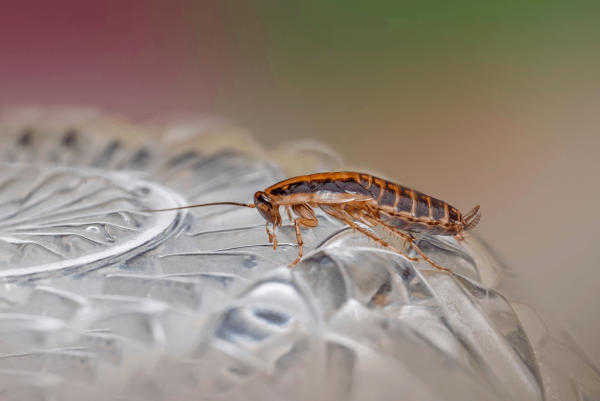
German cockroaches are the small tan ones, and a single egg case holds up to about 40 eggs. Treating one unit rarely holds, because the survivors walk back through the wall cavity a fortnight later.
American cockroaches are the big reddish-brown ones residents photograph in the stairwell at midnight. They breed in the wet parts of the building, not in kitchens, so that one is a common area job.
Rodents in shared walls and roof cavities
Rats and mice travel through common property, which makes rodent control an owners corporation job. They run the pipe runs, cable trays and wall cavities no lot owner can do anything about.
Check the bin room, roller door, subfloor vents and roof line first. Baiting one unit while the bin room stays propped open is money down the drain. Rodents chew cabling, so this is a fire risk as much as a hygiene one.
Ants in common areas and garden beds
Ants nearly always nest outside, in common property gardens, paths and retaining walls, then forage into ground-floor units. The treatment follows the nest, so it belongs to the owners corporation. Expect complaints to spike in spring, as our guide to spring pests in Sydney explains.
Termites: high risk in older Sydney strata
Termites are the most expensive risk your building faces. What they eat is the structure, which is common property, so the duty and the bill land with the owners corporation.
The older walk-up blocks across Canterbury-Bankstown, Belmore and Lakemba are the usual candidates, with timber subfloors and gardens grown hard against the slab. Villa complexes add timber fences and retaining walls.
Strata policies generally exclude termite and vermin damage, which turns a missed colony into a special levy. An annual termite inspection costs a fraction of it.
How professional strata pest control works
Strata pest control runs as a scheduled program, not a one-off callout. Each visit pairs the common area treatment with resident notification and a written report you can file.
Building-wide treatment vs unit-by-unit
Building-wide treatment beats unit-by-unit in almost every strata case, because pests move between lots through shared cavities. Going flat by flat only suits an isolated problem, like bed bugs in one unit.
The catch is that the owners corporation can only treat common property, which leaves the inside of every lot untouched. Knockdown offers residents a treatment of their own unit at cost price, as long as it runs alongside the common area visit. The building gets proper coverage without the owners corporation funding private work.
What to tell residents before treatment
Residents need written notice well before treatment day, because most access refusals trace back to someone finding out on the morning.
Knockdown sends an owner and occupier letter two weeks ahead of a common area treatment, with a copy to the strata manager for the notice boards. A useful notice covers:
- The date, start time and which areas are being treated.
- What is being used, plus safety notes for pets and young children.
- The option to have their own unit done at the same visit, and the price.
- Who to call with questions.
How often should a strata building be treated?
Most Sydney strata buildings need a common area treatment every three to six months, plus a termite inspection at least every 12 months. Buildings with shared bin rooms or a cockroach history belong at the quarterly end.
- Common area treatment quarterly for apartment blocks, or six-monthly for smaller villa and townhouse complexes.
- Termite inspections at least annually under AS 3660.2, and more often near bushland or over timber subfloors.
- Rodent baiting monitored monthly to quarterly through autumn and winter.
Scheduling beats reacting to complaints. It costs less over a year, and it leaves the paper trail showing the owners corporation met its section 106 duty.
Questions to ask your pest controller before booking
These questions separate contractors who understand strata from general residential operators. Ask before you sign, not after the first round of complaints.
- Who writes the resident notices, and how far ahead do they go out? If the answer is your office, that is an afternoon gone every quarter.
- Can residents add their own unit to the visit, and at what price? This one decides whether a cockroach treatment holds.
- What do we get in writing afterwards? Areas treated, products used and recommendations, for the compliance file.
- Are your technicians licensed, and what are they spraying? Residents will ask you, so have the answer first.
- What happens when an occupier refuses access? A strata contractor already knows the section 122 process.
- Do you inspect for termites to AS 3660.2? Quoting it with the common area visit usually beats booking it separately.
Knockdown has worked with strata managers and owners corporations for more than 20 years, across 10,000+ homes and buildings. Our technicians are licensed and trained in application technique, and we use products approved by the World Health Organization and the Ministry of Health. Our strata pest control program covers Canterbury-Bankstown, Belmore, Lakemba and the North Shore.
FAQ: people also ask
Who is responsible for pest control in strata NSW?
In NSW, the owners corporation is responsible for pest control on common property under section 106 of the Strata Schemes Management Act 2015, and lot owners are responsible for pests inside their own lot. If the infestation started in common property, such as a bin room or roof void, it stays the owners corporation's responsibility even after it spreads into units.
How often should strata do pest control?
Most Sydney strata buildings treat common areas every three to six months, and quarterly where there are shared bin rooms or food businesses. Termite inspections should happen at least every 12 months under Australian Standard AS 3660.2, and more often near bushland or over timber subfloors.
Can a tenant request pest control in strata?
Yes. The tenant reports it to their landlord or managing agent, who must provide premises that are reasonably clean and fit to live in under the Residential Tenancies Act 2010. See our pest control for rentals and property managers. If the pests are coming from common property, the owners corporation arranges treatment.
What pests are most common in Sydney apartments?
German cockroaches are the most common pest in Sydney apartments, followed by American cockroaches, rats and mice, ants and silverfish. German cockroaches spread between units through shared walls and pipe risers, which is why treating one unit alone often fails.
Does strata insurance cover pest damage?
Generally no. Strata building policies typically exclude damage caused by vermin, insects and termites, so termite repairs usually come out of the capital works fund or a special levy. Check your scheme's product disclosure statement, because wording varies between insurers.
How much does strata pest control cost in Sydney?
Strata pest control is quoted per building, not at a flat rate. Price depends on the number of blocks, the size of the common areas, the pests involved and how often you schedule treatment. Owners corporations must get at least two independent quotes for work valued at $30,000 or more.
Can I get pest control done in my apartment without body corporate approval?
Yes. A lot owner can arrange pest treatment inside their own lot at their own cost, because the interior is their responsibility. Treating common property, such as roof voids or gardens, has to go through the owners corporation.
Protect your building and your residents. Talk to us about a strata pest management plan.
Call 1300 262 463