

Quality Services Guaranteed!

We’ll beat any legitimate quote!
Flying Ants vs Termites: How to Tell the Difference in NSW
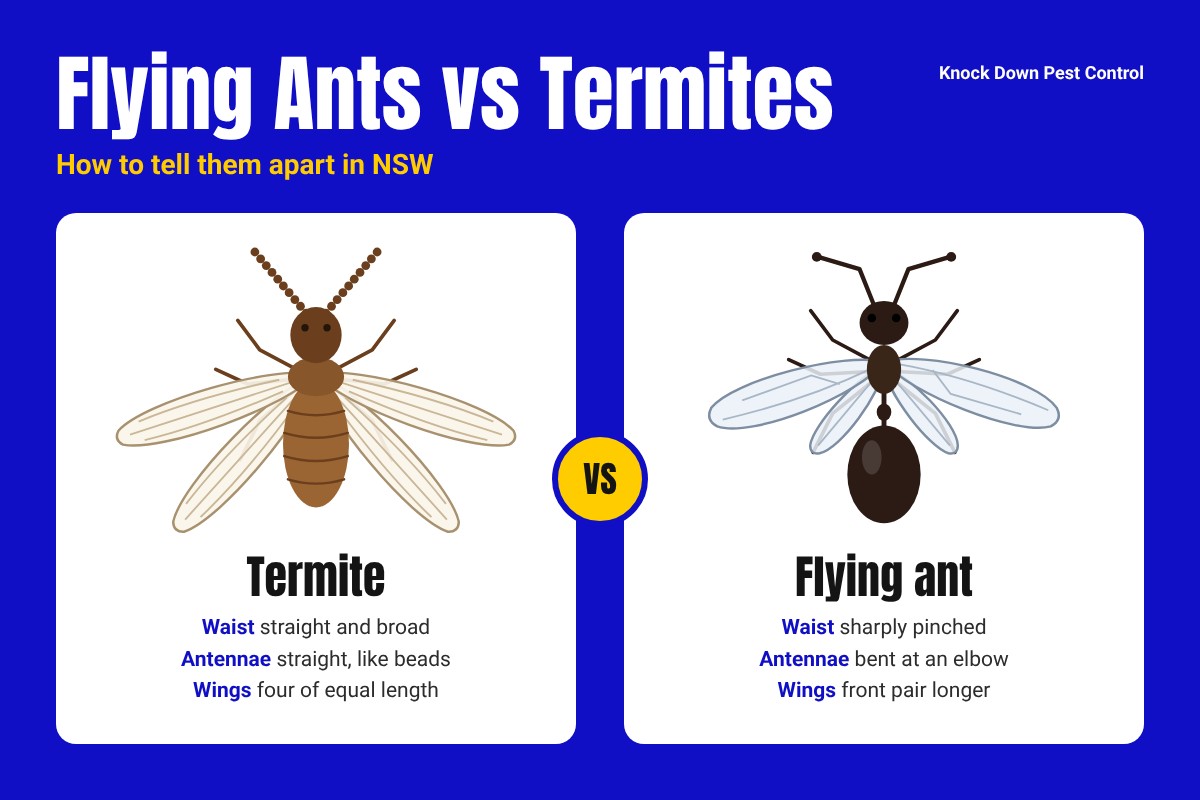
TL;DR: The quickest way to settle flying ants vs termites is to look at the waist, the antennae and the wings. Termites have four wings of equal length, a broad straight waist and straight antennae that look like a string of tiny beads. Flying ants have a pinched waist, elbowed antennae and front wings that are longer than the back pair. If you find wings that snap off easily and pile up near a window, treat them as termites until proven otherwise.
- What are flying ants and termites actually doing when they swarm?
- How do you tell a flying ant from a termite?
- When do termites swarm in Sydney and on the Central Coast?
- What does it mean if you find them inside the house?
- What about white ants?
- Should you spray them?
- What should you do next?
- What are the most common questions about flying ants vs termites?
What are flying ants and termites actually doing when they swarm?
They are leaving an established colony to start a new one. This is a normal part of life for both insects.
The winged insects you see are called alates. An alate is a winged adult whose only job is to breed. Termites with wings and flying ants are both alates. Worker ants and worker termites never grow wings.
A swarm is when a colony releases a large group of alates at the same time. They fly out, find a partner, drop their wings and try to start a new colony. Most do not survive.
A termite swarm does tell you one useful thing. A colony old enough to produce alates is somewhere nearby.
How do you tell a flying ant from a termite?
Check the waist, the antennae and the wings. Those three features separate the two insects far more reliably than colour or size.
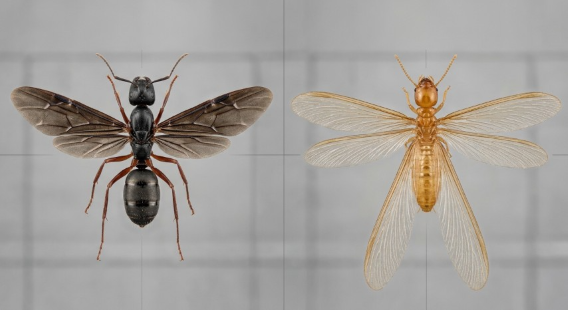
A termite alate is a winged termite with a thick, straight waist, straight bead-like antennae and four wings of equal length, while a flying ant has a narrow, pinched waist, bent antennae and front wings that are longer than its back wings.
Quick tipIf you can, trap one under a clear glass and shine your phone torch from the side so the outline stands out.
| Feature | Termite alate | Flying ant |
|---|---|---|
| Waist | Broad and straight, with no narrowing | Sharply pinched, like a thin stalk |
| Antennae | Straight, made of small bead-like segments | Bent partway along, with a clear elbow |
| Wings | Four of the same size, much longer than the body | Front pair noticeably bigger than the back pair |
| Colour | Usually light to dark brown, with milky or smoky wings | Black, brown or reddish, with clearer wings |
| Behaviour when disturbed | Flutters weakly and drops its wings easily | Runs off quickly and keeps its wings on |
Waist. A termite looks like one thick tube from head to tail. An ant has a tight, thin join between its chest and abdomen.
Antennae. Termite antennae point straight out and look like tiny beads threaded on a string. Ant antennae bend sharply partway along, like an arm at the elbow.
Wings. All four termite wings match in size and reach well past the tail. On a flying ant, the front wings are clearly larger than the hind wings.
Colour. This is the weakest clue. Termite alates in NSW are usually brown with cloudy wings, while flying ants in Australia range from black to reddish brown. Use colour only to back up what the waist and antennae show.
Behaviour when disturbed. Termite alates are clumsy fliers that crowd around lights and lose their wings at the slightest touch. Flying ants scurry away when brushed, and their wings tend to stay attached.
When do termites swarm in Sydney and on the Central Coast?
Termites usually swarm on warm, humid evenings, often after rain. The exact timing varies by species and location, so there is no fixed date to watch for.
Alates need moist air and damp ground to start a colony, so a swarm often follows a storm or a run of sticky weather in the warmer months.
In Sydney, a still, muggy evening after rain is a common trigger. On the Central Coast, many homes sit close to bushland, so alates from nearby trees and stumps can be drawn towards house lights.
Flying ants respond to similar weather, which is one reason the two get mixed up.
What does it mean if you find them inside the house?
A few alates near a window or light usually means they flew in from outside. Alates coming out of walls, floors or skirting boards is the more concerning sign, because the colony may be in or under the house.
- A few near a window or light. Alates are drawn to light. If a door was open or a light was on near an unscreened window, a handful may have come in from a colony in the yard or the street. A colony is active nearby, though not necessarily in your home.
- A swarm emerging indoors. If many alates appear in a room with the doors and windows shut, look for where they are coming from. Common exit points include cracks in plaster, gaps along skirting boards and the edges of window and door frames.
- Discarded wings. Termite alates shed their wings soon after landing. Small piles of identical wings on a windowsill, inside a light fitting or caught in a cobweb are a strong clue that termites have been there.
Found a pile of wings or a swarm indoors? Book a termite inspection or call 1300 262 463.
What about white ants?
White ants and termites are the same insect. White ant is an old Australian name for a termite, and many people still use it.
If you have been searching for white ants vs termites, there is no difference to find. Termite workers are pale and live in colonies, so people took them for ants. Termites are more closely related to cockroaches than to ants.
When a pest technician in Sydney or on the Central Coast mentions white ants, they mean termites.
Should you spray them?
No. Spraying the winged insects does nothing to the colony they came from.
The workers, soldiers and queen stay hidden in the soil or inside timber, where a surface spray cannot reach them. Killing the alates you can see leaves the colony as it was.
Spraying makes inspections harderTermites that are disturbed may move away from where they were active, which makes their entry point harder to trace.
To clean up, keep a few alates in a sealed bag, then vacuum the rest. Leave walls, skirting boards and any mud tubes alone until they have been checked.
What should you do next?
Keep a sample, take a few clear photos and book a termite inspection if there is any chance they are termites. An inspection confirms what you found and where it came from.
A licensed inspector checks the home inside and out, including the roof void, subfloor and yard where they can be reached. You receive a written report that explains what was found and what, if anything, needs to happen next.
If the insects turn out to be flying ants, our ant control service targets the nest rather than the few ants you can see. If termites are confirmed, the options are set out on our termite treatment Sydney page, and our article on how much a termite treatment costs explains what affects the price.
When you are ready, you can book a termite inspection or contact our team with your photos and questions. Prefer to talk? Call 1300 262 463.
What are the most common questions about flying ants vs termites?
Most questions come down to identification, risk to the house and whether one sighting needs follow-up. The short answers are below.
Are flying ants and termites the same thing?
No. They are different insects that both produce winged adults. Termites have a straight waist, straight antennae and four equal wings. Flying ants have a pinched waist, bent antennae and larger front wings.
Do termites have wings all year round?
No. Only the breeding alates have wings, and a colony releases them in batches, usually in warm, humid weather. Worker and soldier termites never have wings.
How long do flying ants live?
Not long once they leave the nest. Males usually die within days of mating. A mated queen drops her wings and can live for years.
Can flying ants damage my house?
No. Ants do not eat timber, so they are not a structural risk in the way termites are. Some ants nest in timber that is already damp or rotting.
What do termite wings look like?
They are long, narrow and all about the same size. They are pale and often slightly milky, with fine veins. They break off easily and collect in small piles.
Do I need a termite inspection if I only saw one?
One alate can fly in from outside, so it is not proof of termites in your home. If you are unsure what it was, or you find wings indoors, an inspection is the reliable way to find out.
Are flying ants a sign of an existing nest?
Yes. Flying ants come from a mature nest, which may be in the garden, under paving or inside a wall. Seeing them indoors repeatedly suggests the nest is close by.
What is the difference between a termite and a white ant?
There is none. White ant is a common Australian name for a termite. Both names describe the same insect.